Fleet management SaaS
Odobase: fleet operations for car rental
Odobase is the fleet and trip platform we built and run for car rental and transport companies, with a web dashboard for the office and an Android and iOS app for drivers.

- Client
- Odobase
- Industry
- Car rental and transport
The product
Odobase lets a rental or transport company book trips, dispatch drivers and invoice the work from one dashboard instead of spreadsheets and group chats. Drivers run their trips from an Android app, and customers get booking forms, quotes, a live trip page and a portal of their own.
The Odobase product page covers what it does for a fleet. This case study is about how we built it and the engineering decisions behind it.
The challenge
A rental business runs on records that are usually made after the fact: who drove, when the trip started, how far it went, what was billed. To be useful, Odobase had to capture those records at the source and keep them correct all the way to the invoice.
Drivers are not office users
A driver can move from one company to another, and has no password or office account. Drivers needed a sign-in built on a phone number and a short PIN that does not log them out in the middle of a shift.
Money that must not drift
Prices quoted to a customer, VAT per line and credit notes all have to add up the same way on the screen, on the PDF and in the reports.
Customers in more than one language
Operators work in English, Arabic, Urdu and other languages, and Arabic invoices need proper right-to-left shaping in the PDF.
Paid APIs on every screen
Maps, places lookups, flight data and WhatsApp messages all cost money per call, so usage had to be designed in, not discovered on the bill.
What we built
The parts of Odobase, each with the engineering that holds it together.
Trips, dispatch and the roster
Trips are scheduled, assigned a vehicle and a driver, and tracked through their status from one screen.
- Recurring trips and a weekly roster
- Trips that can be paused and resumed
- Self-drive hire with vehicle availability
The driver app and its API
A versioned HTTP API that the Android and iOS driver app talks to, documented endpoint by endpoint.
- Sign-in with a phone number and a 4-digit PIN
- Two tokens on every call: one for the app build, one for the driver
- Trip assignment and cancellation pushed through Firebase Cloud Messaging
- GPS points recorded about every 30 seconds during a trip
Customer messages and the trip page
Customers hear about their trip at each step and can follow it on a live trip page linked from every message.
- WhatsApp Business messages on the WhatsApp Cloud API
- Email notifications
- A public trip link with the company’s own branding
Bookings, quotes and the customer portal
Public booking forms create leads, leads become quotes, and accepted quotes become trips, all priced on the server.
- Price lists and instant quotes
- Quote PDFs
- A portal for customers and company accounts with one-time-code sign-in
Invoicing and VAT
Invoices are raised from completed trips, with VAT calculated per line and snapshotted onto the invoice.
- Credit notes with their own gapless numbering
- Bilingual PDFs rendered with mPDF
- Accounting reports and CSV exports
Flight tracking
Airport pickups follow the flight, and a delayed flight moves the trip through one controlled write.
- Flight data behind a provider interface
- A daily call budget set by staff
AI copilot and receipt checks
AI features run on laravel/ai behind one recorder, so every call is logged and metered per company.
- Providers and models managed by staff
- A fallback model on failure
- AI switched off until a company turns it on
Privacy tools
A privacy module for customer data export and erasure, with consent history and retention.
- Data export as a ZIP
- Erasure that keeps issued invoices intact
- Two-factor sign-in for the dashboard
Architecture
Odobase is a Laravel application with an Inertia.js, React and TypeScript dashboard, PostgreSQL for data, Horizon on Redis for queues and Laravel Reverb for real-time updates. A Filament panel gives our staff a cross-company admin tool, kept apart from the customer dashboard.
Single-database multi-tenancy
Every company’s rows share the same tables, separated by a company id and a global scope from spatie/laravel-multitenancy. Tests fail if a new company-owned model skips any of the steps that keep it isolated.
Six surfaces, six hosts
The marketing site, the dashboard, the driver API, the staff admin, the public booking pages and the customer portal each answer on their own hostname, and code asks which surface a request is on by host, never by path.
Controller, service, repository
Controllers never query the database. Services hold the business rules and repositories hold every query, which keeps each domain testable on its own.
Money as exact decimals
Amounts are stored as fixed decimals and calculated as strings with bcmath, with one per-line tax calculator. Integer minor units appear only at a payment gateway’s edge.
An outbox for side effects
Anything that must happen after a change, like a customer message or a flight subscription, is recorded as an event inside the same transaction and relayed after commit. Handlers are keyed on the event id, so a retry never sends twice.
Paid APIs kept in check
Every billable Google Maps product has a daily tally. Route plans are cached in a table for up to Google’s 30-day limit, and address autocomplete checks the company’s own recent places before calling Google.
Modules that fail closed
Optional features such as recurring trips, self-drive hire and customer messaging are modules switched on per company, and a module with no setting stays off.
Where it is now
Odobase is live at odobase.com. The dashboard runs in six languages: English, Spanish, French, Italian, Arabic and Urdu, with right-to-left layouts for Arabic and Urdu. Public plans run from a free Starter plan through Essentials at $29, Growth at $79 and Professional at $149 a month, with a custom Enterprise tier and a 14-day trial on paid plans.
The marketing site is a separate static Astro build, so the product and its public pages ship on their own schedules.
More projects
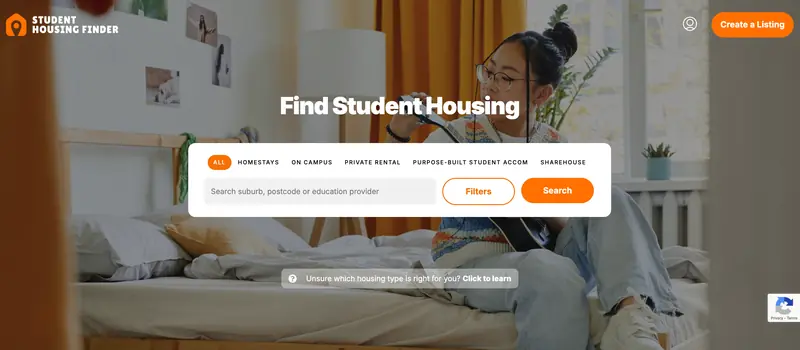
Student housing platform
Student Housing Finder
A web platform that simplifies the accommodation search for students studying across Australia, with search built around their universities.
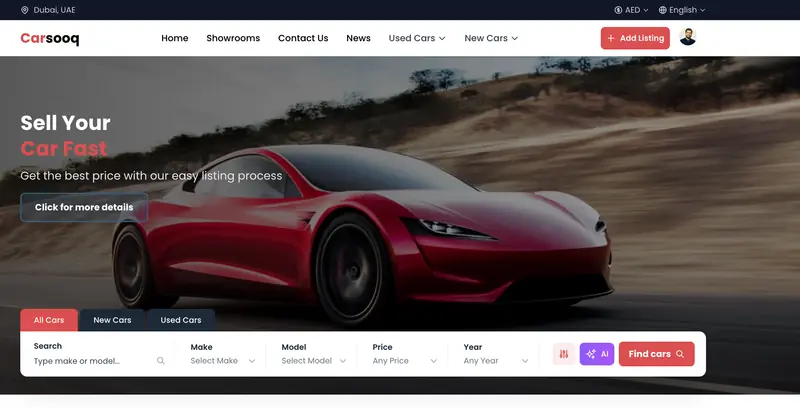
Car marketplace
Carsooq
A marketplace where UAE car showrooms list their vehicles, gain market exposure and generate quality leads, with AI-powered search.


Have a similar project in mind?
Tell us about your project. We’ll reply within 24 hours with a clear plan and estimate.